
Alliaria petiolata (M. Bieb.) Cavara & Grande (= Alliaria officinalis Andrz. ex Bieb.) garlic mustard, alliare officinale
Self-incompatible winter annual or biennial herb; erect; flowers white; locally common in the east, but rare in the west; occurs along roadsides, in open woods and near early European settlements. It can become an invasive plant in semi-shaded and shaded habitats. Cows eating garlic mustard can produce milk with a disagreeable flavor. Originally introduced from Europe for use as a medicinal and salad plant.
Barbarea vulgaris W.T.Aiton, yellow rocket, barbarée vulgaire
Biennial or short-lived perennial, spreading mostly by seeds; allogamous; stems to 2 feet (6 dm.) high; flowers yellow, one of the first weeds to flower in the spring; throughout our area, but particularly common in the eastern part of our range; mostly in non-cultivated fields, roadsides and waste places; introduced from Europe.
Berteroa incana (L.) DC., hoary alyssum, bertéroa blanc
Annual or winter annual herb; semi-erect; flowers white. Sporadic, but locally abundant, especially on poorer soils. Occurs in non-cultivated fields, along roadsides, in waste places, and around settlements. Introduced from Europe. Contamination by hoary alyssum in hay by more than 30% can cause lameness and, in extreme cases, the death of horses.
Brassica juncea (L.) Czern., Indian mustard, moutarde d’Inde
Annual, spreading by seeds; stems to 4 feet (12 dm.) high; flowers yellow; throughout our area, but most common in the mid-west; cultivated fields, roadsides, and waste places; introduced from Europe and Asia.
Brassica rapa L. [ =Brassica campestris L.], bird rape, moutarde des oiseaux
Annual or winter annual, spreading by seeds; stems 8 inches to 3 feet (20 cm. to 9 dm.) high; flowers yellow; throughout our area, but most common in the eastern and western maritime parts; cultivated fields, waste places, and roadsides; introduced from Europe and Asia.
Camelina microcarpa DC., small-seeded false flax, caméline à petits fruits
Annual or winter annual, spreading by seeds; autogamous; stems 1 to 3 feet (3 to 9 dm.) high; flowers pale yellow; throughout our area, but much commoner in the mid-west; open prairie, cultivated fields, roadsides, railway beds, and waste places; introduced from Europe and Asia. Originally spread as a contaminant in flax and grain seed.

Capsella bursa-pastoris (L.) Medik., shepherd's purse, bourse-à-pasteur
Annual or winter annual, propagating by seeds; autogamous; stems very short to 3 feet (9 dm.) high; flowers white; present in all settled areas within our range; cultivated fields, pastures, meadows, roadsides, railway beds, and waste places; introduced from Europe. Recorded in New England as early as 1672.
Cardaria chalepensis (L.) Hand.-Mazz., lens-podded hoary cress, cranson rampant
Strongly rhizomatous perennial; allogamous; stems 8 inches to 2 feet (20 cm. to 6 dm.) high; petals white; an aggressive weed in the dryer areas of the mid-west and west, very rare in the east; cultivated land, hayfields, roadsides, and waste land, especially where irrigated. Both this weed and globe-podded hoary cress (Cardaria pubescens) were introduced into North America in alfalfa imported from Turkestan in 1911 and 1912. They are, even now, often found growing together at the same location. However, lens-podded hoary cress is by far the most aggressive weed.
Conringia orientalis (L.) Dumort., hare's-ear mustard, vélar d’Orient
Annual or winter annual, spreading by seeds; autogamous;stems 6 inches to 2 feet (15 cm. to 6 dm.) high; the entire plant is slightly succulent; flowers creamy white; throughout our range, but most common in the mid-west; grain fields, gardens, waste places, railroad beds , and roadsides; introduced from Europe.
Descurainia sophia (L.) Webb ex Prantl, flixweed, sagesse-des-chirurgiens
Annual or winter annual, spreading by seeds; autogamous; stems up to 3 feet (9 dm.) high; flowers yellow; found throughout our area, but most common in the mid-west; disturbed grasslands, hayfields, roadsides, and waste places; introduced from Europe.
Draba nemorosa L., wood whitlow-grass, drave des bois
A small autogamous annual or winter annual with pale yellow flowers; native to the western half of our area and introduced in the eastern half. It has colonized a wide range of disturbed habitats both within and outside of its native range.
Erucastrum gallicum (Willd.) O.E.Schulz, dog mustard, moutarde des chiens
Annual or winter annual, spreading by seeds; autogamous; stems 6 inches to 2 feet (15 cm. to 6 dm.) high; flowers pale yellow; throughout our area, but reaches its greatest abundance in the mid-west; cultivated fields, roadsides, railway beds, and waste places; introduced from Europe and Asia. It was first seen in 1903, in the United States.
Erysimum cheiranthoides L., wormseed mustard, vélar fausse-giroflée
Annual or winter annual, reproducing by seeds; autogamous; stems 3 inches to 4 feet (8 cm. to 12 dm.) high; present throughout our area; in a wide range of disturbed habitats, but is usually sparse at any single location; introduced from Europe and Asia. It was first recorded, in Virginia, in 1814.
Erysimum hieraciifolium L., tall wormseed mustard, vélar à feuilles d’épervière
Biennial to perennial, reproducing by seeds; apomictic; stems 6 inches to 6 feet (15 cm. to 18 dm.) high; flowers yellow; eastern part of our range; reaches its greatest abundance, and is spreading rapidly in roadsides, gravel pits, pastures, and hayfields in eastern Ontario, and northeastern New York. It was first recorded at Ottawa, Ontario, in 1941; introduced from Europe.
Hesperis matronalis L., dame’s-rocket, julienne des dames
Perennial, often many stemmed, 3 feet. (9 dm.) tall or higher. Flower color varies from white to purple. Introduced from Europe as an ornamental plant and now naturalized near old garden sites, in waste places, and along roadsides. It is locally a troublesome weed in Alaska, Canada, and the northern United States. It is sometimes confused with species of the genus Phlox. The flowers of dame’s-rocket have 4 petals and the stems have alternate leaves; Phlox always has 5-petalled flowers and stems with opposite leaves. Our dame’s-rocket has the chromosome number of 2n= 24.
Lepidium campestre (L.) R.Br. in W.T.Aiton, field pepper-grass, lépidie des champs
Annual or winter annual, spreading by seeds; autogamous; 6 to 18 inches (15 to 45 cm.) high; flowers white; throughout our area, but most common in the southern parts of the eastern non-maritime regions, and in southern British Columbia, western Montana, Idaho, Washington, and Oregon; cultivated fields, roadsides, waste places, and railroad beds; introduced from Europe.
Lepidium densiflorum Schrad., common pepper-grass, lépidie densiflore
Annual or winter annual, spreading by seeds; autogamous; stems 8 inches to 2 feet (20 cm. to 6 dm.) high; flowers white, but inconspicuous; throughout our range, native to dry areas of mid-west and west, and introduced elsewhere; prairie, rangelands, cultivated fields, roadsides, and waste places.
Lepidium virginicum L., poor-man's pepper-grass, lépidie de Virginie
Annual, spreading by seeds; autogamous; stems a few inches to 2 feet (a few cm. to 6 dm.) high; flowers white; eastern North America, southwestern British Columbia, and western Washington and Oregon; mostly in roadsides, waste places, and around settlements; native to North America, but probably seldom in its native habitats.
Neslia paniculata (L.) Desv., ball mustard, neslie paniculée
Annual or winter annual, spreading by seeds; autogamous; plants 1 to 3 (3 to 9 dm.) high; flowers bright yellow; throughout our area, but most common in cultivated fields of the mid-west; cultivated fields, roadsides, railway embankments, waste places, and near grain elevators; introduced from Europe. Its pods, that do not open when ripe, are a frequent impurity in grain seed.
Raphanus raphanistrum L., wild radish, radis sauvage
Annual or winter annual, spreading by seeds; stems 1 to 3 feet (3 to 9 dm.) tall; flowers usually yellow, but sometimes also white or purple in the west, where it probably hybridizes with the cultivated radish; abundant in cultivated fields, roadsides, and waste places along the Atlantic seaboard, in southwestern British Columbia, and in western Washington and Oregon; introduced from Europe.
Rorippa sylvestris (L.) Besser, creeping yellow cress, rorippe sylvestre
Rhizomatous perennial, spreading mainly by root fragments; flowers on the same plant are self-incompatible, and since, at most locations all plants are genetically one plant that have become established and spread by root fragments, creeping yellow cress rarely produces seed pods and seeds in nature; flowering stems 3 to 12 inches (8 to 30 cm.) high; throughout our area and often locally weedy, especially in moist habitats; gardens, ditches, disturbed stream banks, plant nurseries, and waste places; introduced from Europe.
Sinapis arvensis L., wild mustard, moutarde des champs
Annual, reproducing by seeds; some autogamy, mostly allogamous; stems 1 to 3 feet (3 to 9 dm.) high; flowers yellow; throughout our area but most abundant in the grain fields and grasslands of the mid-west; cultivated fields, row crops, waste places and roadsides. Introduced from the Mediterranean region. Common in the fields at Albany , New York, as early as 1748. Recent reports that this plant was present in the northeastern United States at 8000 years before the present time are unconvincing. Poisoning and death of livestock has occurred when large quantities of screenings were fed to cattle.
Sisymbrium altissimum L., tumble mustard, sisymbre élevé
Annual or winter annual, spreading by seeds; autogamous; flowering stems 1 to 4 feet (3 to 12 dm.) high; pale yellow flowers; throughout our area, but most abundant in grain fields and grasslands of the mid-west; in roadsides, railway beds, and waste places elsewhere; introduced from Europe and Asia. Often breaking off at the base, acting as a tumbleweed for seed dispersal.
Sisymbrium loeselii L., tall hedge mustard, sisymbre de Loesel
Annual or winter annual, spreading by seeds; autogamous; plants up to 4 feet (12 dm.) high; flowers bright yellow; throughout most of our area, but most common in grain fields and other cultivated fields of the mid-west; sporadic in roadsides and waste places elsewhere; introduced from Europe.
Thlaspi arvense L., stinkweed, tabouret des champs
Annual or winter annual spreading by seeds; autogamous; plants very short to 2 feet (6 dm.) high; flowers white; occurs throughout our range; in cultivated fields, hayfields, gardens, roadsides, railway beds, and waste places. Introduced from Europe. A common weed around Detroit as early as 1818. Produces an off-flavor in dairy products when grazed by cows.
Click here for information about all of the weedy mustards of Canada.
All mustard photos labeled WHW are of illustrations prepared by W.H.Wright for Weeds of Canada by Clarence Frankton and Gerald A. Mulligan (1970), Agriculture Canada Publication 948, Ottawa, Ontario, 217 pages.
Click on a photo to view an enlarged image.
| Weed Name | Photo | Weed Name | Photo |
| garlic mustard, alliare officinale |  |
garlic mustard, alliare officinale |  |
| garlic mustard, alliare officinale (mature pods) |
 |
garlic mustard, alliare officinale |  |
| garlic mustard, alliare officinale (close-up) |
 |
garlic mustard, alliare officinale (seedlings in open woods) |
 |
| yellow rocket, barbarée vulgaire |  |
yellow rocket, barbarée vulgaire |  |
| yellow rocket, barbarée vulgaire |  |
yellow rocket, barbarée vulgaire |  |
| yellow rocket, barbarée vulgaire |  |
yellow rocket, barbarée vulgaire |  |
| yellow rocket, barbarée vulgaire |  |
WHW- yellow rocket, barbarée vulgaire: A, plant; B, pod; C, seeds. |
 |
| yellow rocket, barbarée vulgaire (var. arcuata) |
 |
hoary alyssum, bertéroa blanc | .JPG) |
| hoary alyssum, bertéroa blanc | .JPG) |
Indian mustard, moutarde d’Inde |  |
| Indian mustard, moutarde d’Inde (seedling, FF) |
.JPG) |
Indian mustard, moutarde d’Inde (seedling) |
.JPG) |
| WHW- Upper left: Indian mustard, moutarde d’Inde. Upper right: bird rape, moutarde des oiseau. Lower left: black mustard, moutarde noire, Brassica nigra (L.) W.D.J.Koch. Lower right: white mustard, moutarde blanche, Sinapis alba L. In all drawings: A, pods; B, seed |  |
bird rape, moutarde des oiseaux |  |
| bird rape, moutarde des oiseaux |  |
bird rape, moutarde des oiseaux (cotyledon stage) |
.JPG) |
| bird rape, moutarde des oiseaux |  |
bird rape, moutarde des oiseaux (stereoscan photomicrograph of seed coat, from Mulligan & Bailey, Economic Botany 30:143-148, 1976) |
 |
| small-seeded false flax, caméline à petits fruits (herbarium specimen) |
 |
WHW- small-seeded false flax, caméline à petits fruits: A, plant; B, pod; C, seeds. Large-seeded false flax, caméline cultivée, Camelina sativa ( L.) Crantz: D, seeds. |
 |
| shepherd's purse, bourse-à-pasteur |  |
shepherd's purse, bourse-à-pasteur |  |
| shepherd's purse, bourse-à-pasteur (fruiting inflorescence) |
.JPG) |
shepherd's purse, bourse-à-pasteur(NC) |  |
| WHW- shepherd's purse, bourse-à-pasteur: A, plant; B, pod; C, seed. |
 |
lens-podded hoary cress, cranson rampant |  |
| lens-podded hoary cress, cranson rampant (herbarium specimen) |
 |
lens-podded hoary cress, cranson rampant (stems from underground rootstock) |
 |
| lens-podded hoary cress, cranson rampant (top, heart-podded; middle, lens-podded; bottom, globe-podded; from Mulligan & Frankton, Canadian J. Botany 40:1411-1425, 1962) |
 |
WHW- heart-podded hoary cress, cranson dravier, Cardaria draba (L.) Desv.: A., plant; B, pod; C, immature pod; D, seed.Lens-podded hoary cress, cranson rampant: E, pod; F, immature pod.Globe-podded hoary cress, cranson velu, Cardaria pubescens (C.A.Mey.) Jarm.: G, pod; H, immature pod; I, leaf |  |
| hare's-ear mustard, vélar d’Orient |  |
hare's-ear mustard, vélar d’Orient (seedling, FF) |
.JPG) |
| hare's-ear mustard, vélar d’Orient (NC) |
 |
WHW- hare's-ear mustard, vélar d’Orient: A, plant; B, pods; C, cross section of pod; D, seed. |
 |
| flixweed, sagesse-des-chirurgiens |  |
flixweed, sagesse-des-chirurgiens (rosette) |
.JPG) |
| flixweed, sagesse-des-chirurgiens (rosette) |
.JPG) |
WHW- flixweed, sagesse-des-chirurgiens: A, plant; B, pod; C, seed. Green tansy mustard, moutarde-tanaisie verte, Descurainia pinnata (Walter) Britton var. brachycarpa (Richardson) Fernald: D, pods; E, seed. Gray tansy mustard, moutarde-tanaisie grise, Descurainia incana (Bernh. ex Fisch. & C.A.Mey.) Dorn: F, pods: G, seeds. |
 |
| wood whitlow-grass, drave des bois (NC) |
 |
dog mustard, moutarde des chiens |  |
| dog mustard, moutarde des chiens (herbarium specimen) |
 |
dog mustard, moutarde des chiens (seedling) |
.JPG) |
| WHW- dog mustard, moutarde des chiens: A, plant; B, flower; C, pod; D, seeds. |
 |
wormseed mustard, vélar fausse-giroflée | 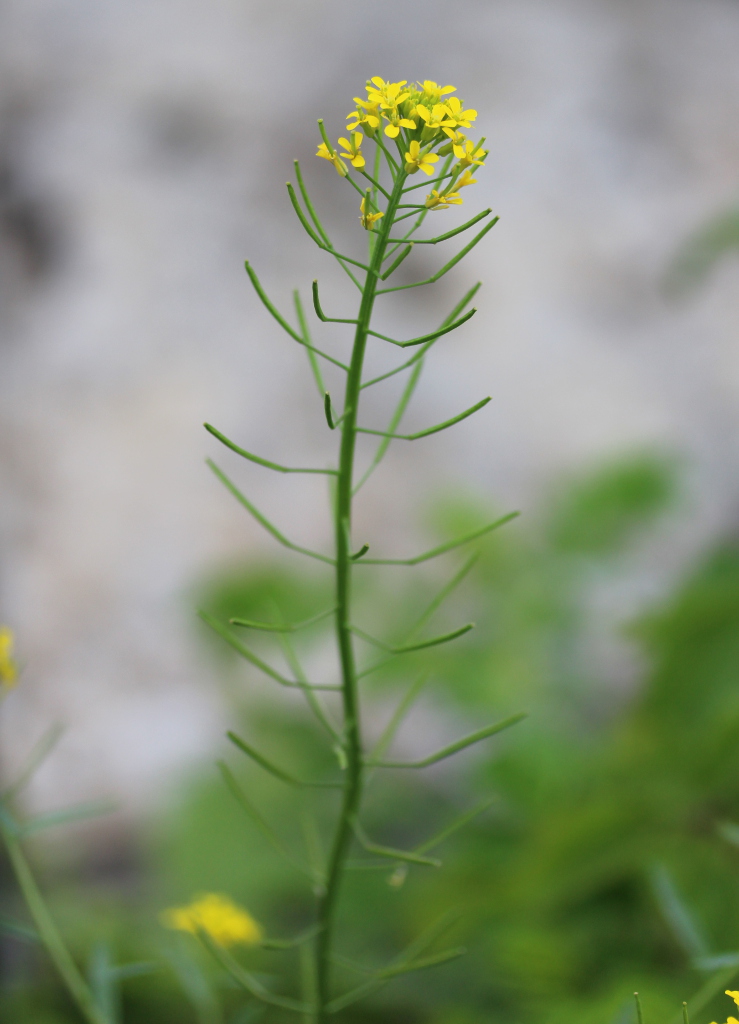 |
| wormseed mustard, vélar fausse-giroflée |  |
wormseed mustard, vélar fausse-giroflée |  |
| wormseed mustard, vélar fausse-giroflée (inflorescence) |
.JPG) |
wormseed mustard, vélar fausse-giroflée (seedling) |
.JPG) |
| wormseed mustard, vélar fausse-giroflée (NC) |  |
WHW- wormseed mustard, vélar fausse-giroflée: A, plant; B, upper part of plant; C, pod; D, seeds. |
 |
| tall wormseed mustard, vélar à feuilles d’épervière |  |
tall wormseed mustard, vélar à feuilles d’épervière |  |
| tall wormseed mustard, vélar à feuilles d’épervière (vegetative) |
.JPG) |
dame’s-rocket, julienne des dames |  |
| dame’s-rocket, julienne des dames |  |
dame’s-rocket, julienne des dames (both white and purple flowers) |
 |
| dame’s-rocket, julienne des dames |  |
dame’s-rocket, julienne des dames |  |
| dame’s-rocket, julienne des dames |  |
field pepper-grass, lépidie des champs |  |
| field pepper-grass, lépidie des champs |  |
field pepper-grass, lépidie des champs (seedling, FF) |
.JPG) |
| WHW- field pepper-grass, lépidie des champs: D, plant; E, pod; F, seed. Common pepper-grass, lépidie densiflore: A, plant; B, pod; C, seed. |
 |
common pepper-grass, lépidie densiflore |  |
| common pepper-grass, lépidie densiflore |  |
common pepper-grass, lépidie densiflore |  |
| common pepper-grass, lépidie densiflore (rosette) |
.JPG) |
common pepper-grass, lépidie densiflore (NC) |  |
| poor-man's pepper-grass, lépidie de Virginie |  |
poor-man's pepper-grass, lépidie de Virginie (fruiting inflorescence) |
 |
| poor-man's pepper-grass, lépidie de Virginie (flowers and fruit) |
 |
poor-man's pepper-grass, lépidie de Virginie (a general view) |
 |
| ball mustard, neslie paniculée |  |
ball mustard, neslie paniculée (seedling) |
.JPG) |
| ball mustard, neslie paniculée (NC) |  |
WHW- ball mustard, neslie paniculée: A, plant; B, pods. |
 |
| wild radish, radis sauvage |  |
wild radish, radis sauvage (seedling, FF) |
.JPG) |
| wild radish, radis sauvage (seedling) |
.JPG) |
wild radish, radis sauvage (NC) |  |
| WHW- wild radish, radis sauvage: A, plant; B, pod; C, seed. Cultivated radish, radis cultivé Raphanus sativus: L. D, pods. |
 |
||
| creeping yellow cress, rorippe sylvestre |  |
creeping yellow cress, rorippe sylvestre (shoots from underground stems) |
.JPG) |
| wild mustard, moutarde des champs (note no pods on isolated plant of allogamous wild mustard) |
 |
wild mustard, moutarde des champs (flower center reflecting wavelengths in ultraviolet) |
 |
| wild mustard, moutarde des champs (seedling) |
.JPG) |
wild mustard, moutarde des champs (seedling) |
 |
| wild mustard, moutarde des champs (stereoscan microphotograph of seed coat, from Mulligan & Bailey, Economic Botany 30:143-148, 1976) |
 |
wild mustard, moutarde des champs (NC) |  |
| WHW- wild mustard, moutarde des champs: A, plant; B, pod; C, seed. |
 |
tumble mustard, sisymbre élevé |  |
| tumble mustard, sisymbre élevé (rosette) |
.JPG) |
tumble mustard, sisymbre élevé (NC) |  |
| WHW- tumble mustard, sisymbre élevé: A, plant; B, pods; C, seeds. |
 |
tall hedge mustard, sisymbre de Loesel |  |
| tall hedge mustard, sisymbre de Loesel (herbarium specimen) |
 |
tall hedge mustard, sisymbre de Loesel (rosette) |
.JPG) |
WHW- tall hedge mustard, sisymbre de Loesel: A, plant; B, pods; C, seeds. Hedge mustard, sisymbre officinal, Sisymbrium officinale (L.) Scop.: D, pods; E, seed |
 |
stinkweed, tabouret des champs |  |
| stinkweed, tabouret des champs |  |
stinkweed, tabouret des champs (F&M) |
 |
| stinkweed, tabouret des champs (NC) |
 |
|
Number of Visitors:
|
|
|